

Every health system has a governance committee. Almost none of them can point to a single time it made someone do something they didn't want to do. That's not a coincidence — it's the default state of committee life in healthcare, and it deserves to be called what it is: governance theater.
The Question We Ask Every Time
When we sit down with a health system leadership team and the word "governance" comes up, we ask one question: do you have a governance committee because it does something, or because you're supposed to have one?
Almost every organization insists it's the former. Almost none of them can demonstrate it.
The Tell
Here's the pattern, and if you've spent any time inside a hospital or health system you'll recognize it immediately. The governance committee meets monthly. The same three or four issues rotate through the agenda in some order, dressed up as whatever the flavor of the week happens to be — capacity, throughput, physician alignment, an EHR optimization initiative, an AI pilot nobody asked for. Someone presents data. Everyone nods. No one leaves the room owning an action with a deadline attached to their name. Next month, the same conversation happens again, sometimes with the same slide.
This isn't unique to whatever committee is nominally in charge of capacity or technology governance — it's the default operating pattern of committee life in a hospital, from the executive committee down to, genuinely, the parking committee. The structure is fine. The ritual is fine. What's missing is the one thing that actually makes something governance instead of bureaucracy: the willingness to make someone do something they don't want to do, and to back that decision when it gets uncomfortable.
This isn't just a feeling. The American Hospital Association's 2022 National Health Care Governance Survey found that 50% of hospital boards rank quality of care among their top two priorities — yet 37% don't put a quality performance review on every single agenda, and 58% spend less than a fifth of their meeting time on it. Zoom out further and the pattern repeats: 70% of boards say they've restructured themselves in recent years specifically to improve governance effectiveness. But 61% of those same boards have no requirement that members pursue any ongoing education on what they're supposedly governing. Change the org chart, skip the substance.
58% of hospital boards spend less than one-fifth of their meeting time on quality — despite naming it a top priority. 37% don't even put a quality review on every agenda.
American Hospital Association, 2022 National Health Care Governance Survey Report
Then Joint Commission shows up, the organization scrambles to demonstrate the governance structure has teeth, gets through survey, and the cycle resets. Nothing changed except everyone's calendar got a little more crowded for a quarter.
Why This Matters More Than It Sounds Like It Does
We see this most clearly in operating room block time — a specific issue and also a stand-in for every difficult resource-allocation decision a health system avoids. Every hospital knows it has surgeons sitting on underutilized block time. Every hospital has a committee, on paper, with the authority to reallocate that time based on actual utilization data. Almost none of them have ever actually done it.
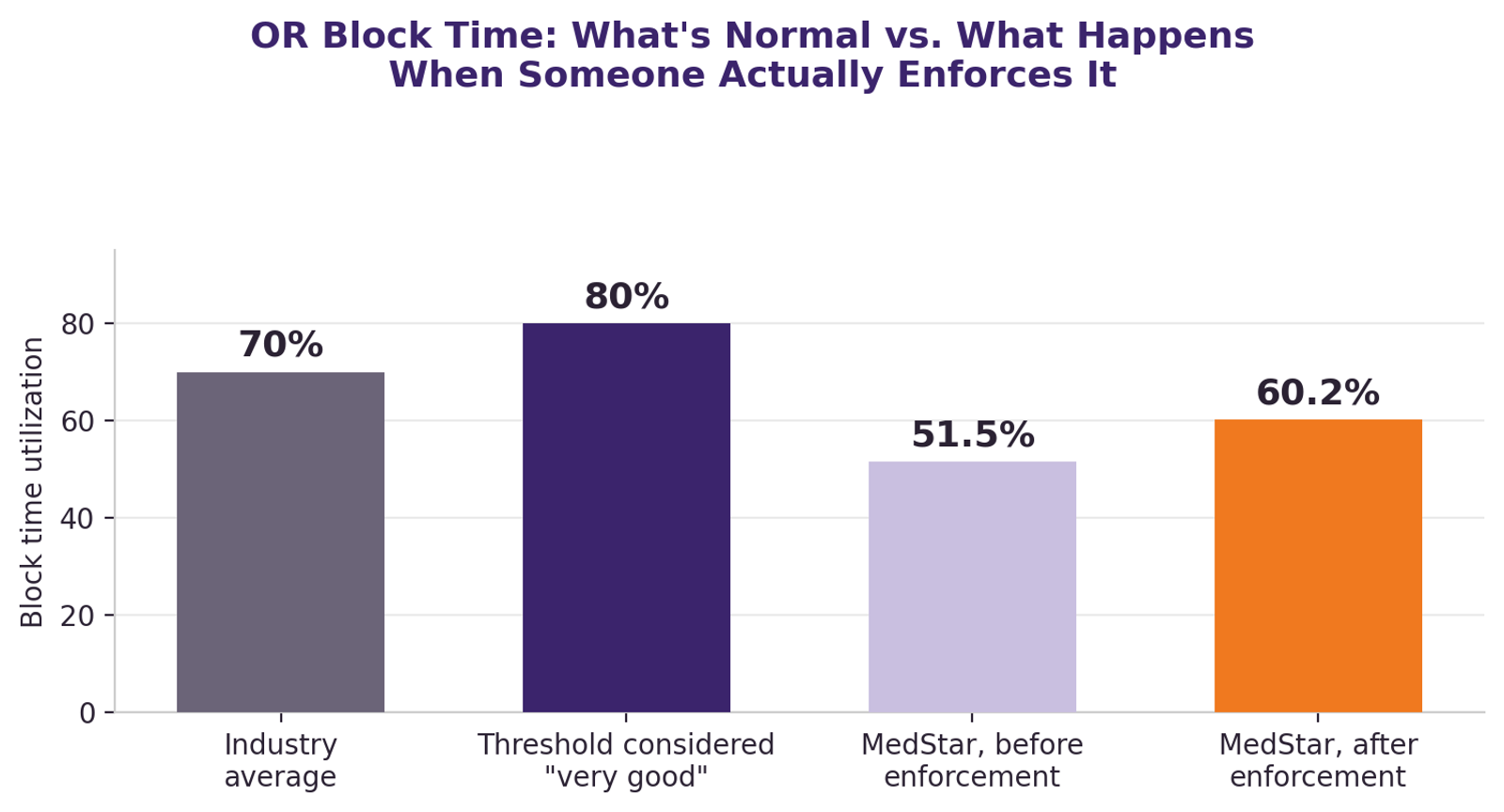
Not because the data doesn't exist. It usually does — industry-wide OR block utilization typically runs 65% to 75%, and anything above 80% is considered rare and very good. Not because nobody proposed it. Someone always has. It's because reclaiming block time means a named person has to tell a surgeon — often a high-revenue, long-tenured, politically connected surgeon — that they're losing something they've held for years. That requires an individual with clear authority, and a leadership team willing to stand behind that individual publicly when the surgeon calls the CEO directly, which they will.
And the money sitting idle in that gap is real: peer-reviewed cost data puts the average cost of OR time at roughly $36 to $37 per minute — about $2,160 to $2,220 an hour of block time nobody is using. That's not a rounding error on a spreadsheet. It's the cost of a meeting that never makes a decision.
Sources: Anaesthesia (Macario, 2010); JAMA Surgery (Childers & Maggard-Gibbons, 2018); MedStar Health / MedStar Institute for Innovation
It can be done. One health system finally built an actual enforcement mechanism around block time — a surgeon-led council with real authority to reallocate, not just review — and watched utilization climb from 51.5% to 60.2% in four consecutive months. The data and the tooling had existed the whole time. What changed was that someone enforced it.
Committees don't do that. People do that. And if your governance structure can't point to a specific person who has done it before, you don't have governance — you have a meeting.
Why This Gets More Dangerous, Not Less, With AI
Everything above is bad enough when the thing sitting idle is an operating room. It gets worse when the thing nobody's actually governing is a system that's already making decisions on its own, at scale, today. A 2026 report from the Center for Connected Medicine at UPMC and KLAS Research found that more than 90% of health systems have already deployed third-party AI into clinical and administrative workflows — but 63% describe their own AI strategy as still "developing or ad hoc" rather than established, and only 44% have a dedicated environment to actually test how these tools perform before they touch patient data. The deployment happened. The governance didn't show up to the meeting.
Run our own diagnostic against that gap and it gets worse. Ask a health system to produce a complete, auditable record of which AI system made which recommendation for which patient over the last 30 days, and a Black Book Research survey of 182 hospital leaders found only 22% were highly confident they could actually do it. That's not a committee failing to enforce a recommendation about block time. That's an organization that couldn't reconstruct what its own systems did last month even if a regulator, or a plaintiff's attorney, asked nicely.
90%+ deployed. 63% still call it "ad hoc." 22% could prove it. The share of health systems that have already deployed third-party AI, the share that admit their AI strategy is still developing or ad hoc, and the share confident they could produce a 30-day audit trail of what their AI actually did.
Center for Connected Medicine at UPMC & KLAS Research, 2026; Black Book Research survey of 182 hospital leaders, via Becker's Hospital Review, November 2025
The committee model can't keep up with the volume either. A June 2026 analysis in Forbes put it bluntly: as AI governance committees have proliferated across health systems, payers and pharma, many "have become bureaucratic hurdles that produce governance theater rather than meaningful risk mitigation." One 2024 survey of 67 health systems found large systems evaluating more than 225 AI proposals to land roughly 40 in production, a ratio that guarantees either the committee becomes a permanent bottleneck or teams quietly route around it. Same failure mode, newest host.
225+ → ~40 AI use cases large health systems evaluate for every ~40 that reach production — a volume no manual committee can meaningfully review.
Scottsdale Institute survey of 67 health systems, 2024 (as reported in JAMIA and Forbes, June 2026)
And unlike block time, the cost of that gap isn't idle capacity sitting on a spreadsheet. "I've seen large language models give completely different responses," Parkview Health CMIO Mark Mabus told CIO magazine in April 2026. "And one of those responses would probably cause patient harm if used." A committee that never enforces anything around OR block time wastes money. A governance structure that never enforces anything around a clinical AI tool is signing off, by omission, on whichever of those different responses the model happens to give the next patient.
The Diagnostic That Actually Tells You Something
Forget asking whether a governance committee exists. Ask three things instead:
- Who, by name and title, has ever actually enforced an unpopular decision this committee recommended? Not who could, in theory. Who has.
- What happened to them when they did? Did leadership back them publicly, or did the decision quietly get walked back the next time the surgeon complained loudly enough?
- What's the oldest unresolved item on this committee's agenda? If the same issue has been "under discussion" for more than two cycles, the committee isn't governing it — it's absorbing it.
If an organization can't answer the first question with a name, everything downstream of that — the technology investment, the AI-driven optimization tool, the outside consultant, the new committee charter — is solving the wrong problem. You don't have a data problem or a tooling problem. You have an accountability problem, and no software fixes that.
Five Tests of Real Governance
Organizations that want to know whether their governance model actually works should apply five tests.
1. Decision Rights
Who can say yes—and who can say no?
Authority must be explicit.
If three committees believe another committee owns the decision, no one owns it.
Every governance body should have clearly documented decision rights, including decisions it owns, decisions it recommends, decisions it escalates, and decisions outside its authority.
2. Named Accountability
Who owns implementation after the decision is made?
"IT," "Operations," "Clinical Leadership," or "the project team" are not accountable individuals.
A person is accountable.
That individual must understand the expected outcome, possess sufficient authority to execute, and know where to escalate obstacles.
3. Time-Bound Action
When does the decision become action?
Every material governance decision should produce an owner, deliverable, and date.
Without a deadline, decisions become recommendations.
Without follow-up, recommendations become agenda items.
And agenda items have an extraordinary ability to survive indefinitely.
4. Escalation Authority
What happens when someone refuses?
This may be the most neglected element of governance design.
Healthcare organizations spend enormous effort defining how decisions are made and surprisingly little defining what happens when those decisions are challenged.
An effective governance model establishes the escalation path before the politically difficult decision occurs.
Otherwise every dispute becomes a negotiation over the governance process itself.
5. Consequence and Measurement
Did anything actually change?
Governance should be measured by outcomes, not activity.
Not:
How many meetings did the committee hold?
But:
How many decisions were made?
How quickly were they implemented?
How many required escalation?
How many remain unresolved?
Did the intended operational, clinical, financial, or strategic result occur?
That is the difference between measuring governance activity and measuring governance effectiveness.
The Point
Governance that doesn't enforce anything isn't governance. It's a scheduled meeting with better lighting. The health systems that actually get value out of capacity optimization, technology investment, or any strategic initiative that requires someone to give something up are the ones where governance means a specific person with real authority, backed publicly by leadership, who has done the hard thing before and will do it again. Everyone else is going to keep having the same meeting until the next survey and calling it strategy.